
Short Stack Strategy: Why Loss Aversion Matters
Playing with a short stack in poker triggers loss aversion in unexpected ways. Richard Thaler predicted this. The data confirms it. The implications are uncomfortable.
Rizz Cash Tape3 min read
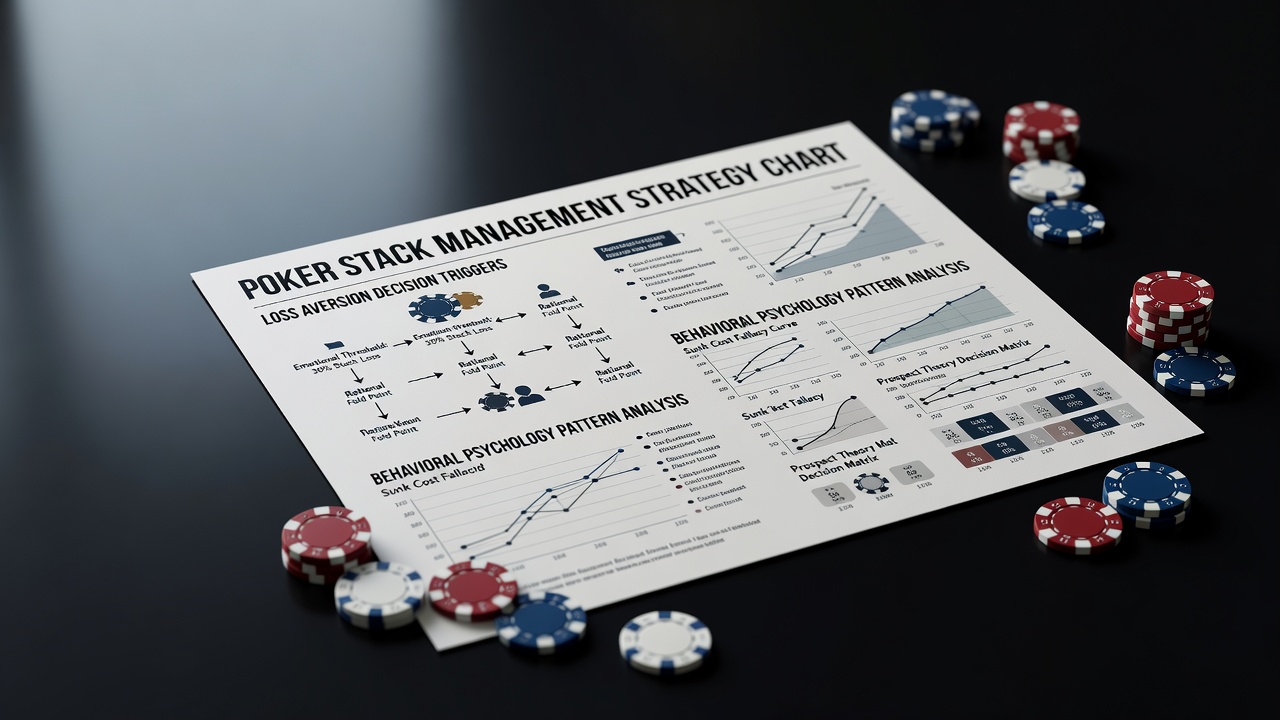
Loss aversion is a well-established principle in behavioral economics. People feel the pain of loss roughly twice as strongly as the pleasure of equivalent gain. A person offered a 50-50 chance at winning or losing $100 will typically refuse, demanding at least a 2-1 ratio to make the bet acceptable.
This principle emerges from human psychology, not rational calculation. A rational gambler treats $100 of loss and $100 of gain with equal weight. A human gambler treats loss as twice as severe.
In poker, loss aversion manifests acutely when a player is short-stacked.
The Short Stack Definition
A short stack in a full ring game is typically defined as fifteen big blinds or fewer. At a table with a $2 big blind, a short stack is $30 or less. At a table with a $10 big blind, it is $150 or less. The exact number varies, but the principle remains: the stack is small relative to the cost of play.
When a player becomes short-stacked, something psychological shifts. The player is no longer playing to win. The player is playing to avoid elimination. Loss aversion, dormant at a normal stack, activates fully.
The Behavioral Shift
Research on poker decision-making shows that short-stacked players make systematically different decisions than players with deeper stacks. They fold more marginal hands. They go all-in with wider ranges. They take more risks, not because the mathematics suggest it, but because the alternative is slow elimination.
This is loss aversion in action. A short-stacked player would rather have a 30 per cent chance of doubling up (and a 70 per cent chance of being eliminated) than a 60 per cent chance of losing another blind. The math favours the 60-40 scenario. The psychology favours the doubling-up attempt.
The Camp Under Pressure
When a player has only fifteen big blinds left, that player is facing elimination anxiety. The pain of slowly bleeding out chips is, psychologically, worse than the pain of going all-in and losing. This is not rational. It is emotional.
Operators of cash games understand this and exploit it. A player with thirty chips left will stay in the game longer if they believe a big win is possible. So the casino ensures that stacks are deep enough at the start but allows them to become short through play. A short-stacked player is an anxious player. An anxious player makes mistakes. Mistakes create losses.
The Calculation Error
Let me be specific about where the short-stacked player's calculations diverge from optimal play.
With a ten-chip short stack at a $2 big blind, a player in late position with Ace-Jack might push all-in. The expected value of this play is negative. An opponent with any Ace, any pair, or King-Queen will have roughly a 50-50 chance or better. The push is mathematically bad.
But psychologically, it is correct. The alternative is folding two more hands, post-blind three more hands, then being forced all-in as the big blind with a random hand. A 30 per cent chance of winning immediately feels better than a 20 per cent chance of surviving two more rounds.
Neither calculation is objectively accurate. Both are driven by loss aversion. The difference is that one is a deliberate choice while the other is passive acceptance.
The Institutional Knowledge
Professional poker players understand this dynamic and weaponise it. When an opponent becomes short-stacked, professional players apply pressure. They raise more frequently. They isolate the short stack. They force decisions.
The short-stacked player, experiencing loss aversion, will eventually break. They will go all-in with a marginal hand. The professional calls with a better hand. The short stack is eliminated.
This is not random variance. This is the exploitation of a known psychological response to loss aversion.
The Practical Implication
For a recreational player, the key insight is this: short stacking is a trap. It triggers loss aversion, which leads to worse decision-making. The best play is to maintain a deep stack. When your stack becomes short, it is often better to cash out than to continue playing from a position where your judgment has been compromised.
This contradicts the common advice to "grind back" a short stack. Grinding back is mathematically possible but psychologically brutal. Loss aversion will fight you every step of the way.
The professional players understand this, which is why they pressure short stacks. They are not trying to beat the mathematics. They are trying to trigger the psychology.