
Legendary Roulette Wins: The Narrative and the Mathematics
Roulette has produced famous wins. Each story has been studied extensively by researchers. The findings are not what you would expect.
Rizz Cash Tape3 min read
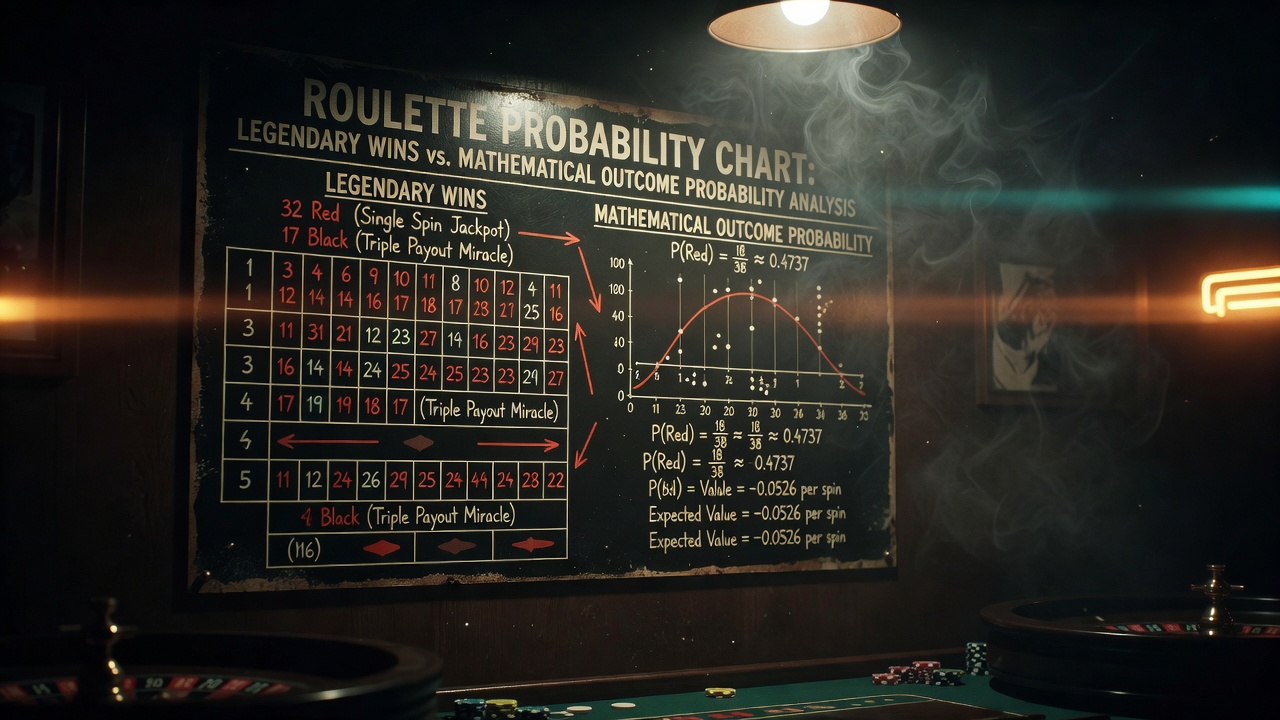
Roulette has generated several legendary wins that live in gambling folklore. In 1873, a man in Monte Carlo played black for twenty-six consecutive spins. Red came up, and then black came up thirty-eight consecutive times. He won a fortune. The story persists.
What researchers find interesting is not the win itself, which is an outcome of probability, but how the narrative around the win shapes subsequent behaviour.
The Narrative Effect
When a legendary win occurs and is publicised, the following effect is observed: recreational gamblers increase their roulette play. They hear the story of the win. They internalise the narrative: "It is possible to win big at roulette." They begin playing more frequently.
This is rational in a limited sense. If big wins occur, why not try? But the probability of the big win is not increased by the story. The story is just information, not a change in the game's mechanics.
The outcome: recreational players play more, lose more, and rarely experience the legendary win themselves. The legend drives the behaviour. The behaviour generates losses.
The Availability Heuristic
The legendary wins are available in memory. They are famous stories that people repeat. This availability makes them seem more likely than they actually are.
Mathematically, a sequence of thirty-eight blacks in a row has a probability of approximately one in 1.5 billion. It occurs roughly once per 1.5 billion spins globally. But because the win was publicised and repeated, a player might unconsciously estimate the probability as "rare but not impossible."
This mismatch between perceived probability and actual probability drives continued play. A player thinks: "This has happened before. Maybe I will be the next person." The probability is so low that they actually should be thinking: "This has happened, but I will never see it in my lifetime."
The Survival Bias
We hear about the legendary wins. We do not hear about the legendary losses, because those are not newsworthy. A man who lost his entire fortune at roulette over decades is not a story. A man who won a fortune in a sequence of lucky spins is.
This creates a survival bias in the available narratives. The stories that reach us are positively skewed. The stories that do not reach us are negatively skewed or neutral.
A rational mind adjusting for survival bias should weight the legendary wins less heavily and the unseen losses more heavily. But people do not do this naturally. The available stories crowd out the unavailable ones.
The Mechanical Explanation
Some legendary wins come with mechanical explanations. In 1963, a roulette wheel at a casino in Las Vegas was found to be slightly biased. One number appeared slightly more frequently than expected. A player had noticed this and exploited it.
This is a different phenomenon. It is not luck. It is information asymmetry. Once the bias was fixed, the advantage disappeared.
However, these mechanical explanations are rare. Most legendary roulette wins are pure variance. Red on black for thirty-eight spins. It happened. The probability was incredibly low. It happens anyway.
The Emotional Impact
When a person hears the legendary win story, the emotional impact is significant. The story activates the reward centres of the brain. The listener imagines themselves in the position of the winner. The dopamine response is real.
This emotional response drives subsequent behaviour. The person seeks to recreate the emotion. They play roulette. They do not win. But the emotional response to the attempt creates a feedback loop.
The Prevention Implication
Research on problem gambling shows that reducing the visibility of legendary wins reduces subsequent gambling. This is not about hiding information. It is about reframing.
Instead of "A man won a million dollars at roulette," the reframe is: "The probability of reproducing this outcome is one in billions. You will not experience this in your lifetime. Playing roulette expecting this outcome is irrational."
This reframe does not eliminate the appeal of gambling, but it reduces the specific appeal of chasing a legendary outcome.
The Research Conclusion
Legendary roulette wins are outcomes of probability. They are not predictive of future events. They are not evidence of exploitable patterns. They are extremely rare events that are memorable because they are rare.
Yet they drive behaviour in players who hear them. This is the research finding. The narrative drives the behaviour. The behaviour generates losses. The cycle continues.