
Craps Records: The Longest Rolls Ever Documented
The longest craps roll on record lasted 4 hours and 18 minutes. It happened in 2009 at the Golden Nugget in Las Vegas. The roller hit 154 rolls without sevening out. What this tells us about the design of craps and the human experience is more interesting than the record itself.
Rizz Cash Tape3 min read
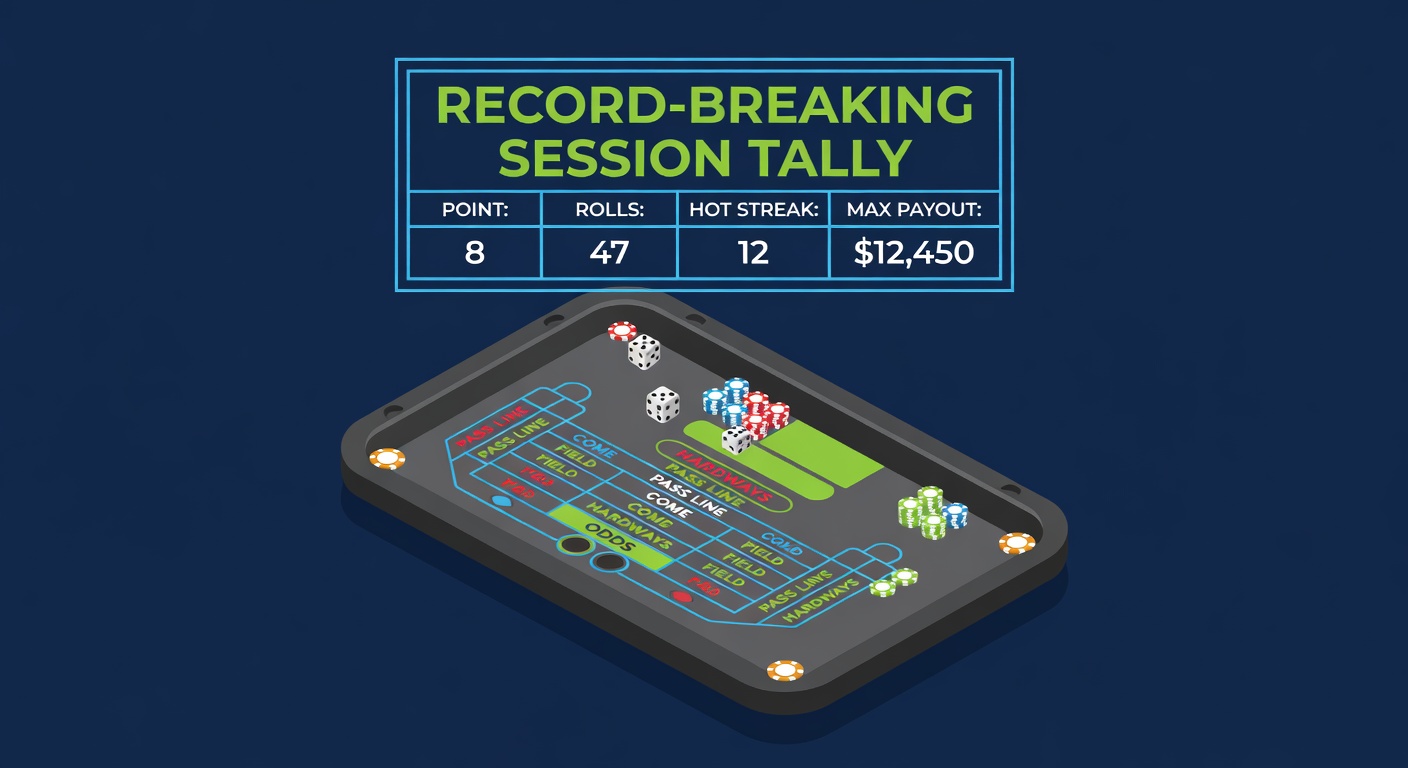
The record for the longest craps roll in a casino is held by Patricia Demauro, who rolled for 4 hours and 18 minutes at the Golden Nugget in Las Vegas on May 23, 2009. She threw 154 consecutive dice rolls without hitting a seven, the number that ends the roll and passes the dice to the next shooter. The odds of this happening are approximately 1 in 1.56 billion. She was a 61-year-old grandmother on her second trip to Las Vegas.
The physical design of a craps table is crucial to understanding why some rolls last as long as they do. The table is 14 feet long and 3.5 feet wide, with walls and a felt surface designed to make dice bounce. The walls are there to ensure randomness; dice cannot simply be tossed and land predictably. The randomness of craps is the entire game. The architecture is built to guarantee it.
When a shooter throws the dice, they should tumble chaotically. The walls force them to. A craps table designed by Suarez Corporation or another major gaming equipment manufacturer includes specific bumps and angles calculated to ensure maximum randomness. The bounce pattern is unpredictable. This is why a 154-roll sequence, while astronomically unlikely, is possible. The system is designed to allow for variance.
The Mathematics of the Roll
The odds of rolling a seven on any given throw are 6 in 36, or 1 in 6. The odds of not rolling a seven are 5 in 6, or roughly 0.833. To calculate the odds of not rolling a seven for 154 consecutive rolls, you multiply 0.833 to the 154th power. The result is approximately 0.000000000637. That is a one-in-1.56-billion event.
But here is the key thing: that probability applies to any specific 154-roll sequence. Since millions of people shoot craps on any given week across casinos worldwide, the probability that someone eventually hits an extreme sequence is much higher than the raw probability would suggest. It is still extremely rare, but not impossible. Demauro's roll was the record documented in a casino setting, but records are broken sometimes.
The longest recorded craps roll in any setting (including informal games) might be longer, but we would have no way to verify it. Casinos keep records on their rolls because they have surveillance, documentation, and professional interest. A private game in someone's home might produce a longer roll and nobody would ever know.
What the Architecture Does
The craps table's design is meant to produce randomness reliably. Sands Casino (now closed) once had a table designed by a specific architect whose name I cannot recall, but the table had a slightly different angle on the back wall, and players reported that the dice behavior was noticeably different. This tells you how sensitive the system is to design details.
Modern craps tables are more standardized. The Nevada Gaming Commission and other regulatory bodies have specifications for table construction. The goal is consistent, reliable randomness. You cannot have a table where certain rolls are more likely than others, not if you are running a fair game.
Patricia Demauro's 154-roll sequence was not a sign that she was special. It was a demonstration that extreme variance is mathematically possible in a well-designed system.
The impact of Demauro's roll on the casino was significant from a business perspective. Her play generated massive house revenue during those 4 hours and 18 minutes. The longer a roll lasts, the more action occurs at the table. Multiple bets are placed on each roll. The house edge on a pass line bet is 1.4 percent. Over 154 rolls, that edge accumulates significantly. The Golden Nugget made money from her roll, even though the story made it seem like she had done something extraordinary.
For someone sitting at that table watching a roll that long, the experience is different than the mathematics. The psychology shifts. After 50 rolls without a seven, observers start to believe that a long roll is happening. After 100 rolls, the atmosphere becomes electric. People gather. Bets increase. The table becomes the place in the casino where things are happening. This is part of the architecture's hidden design: it can produce moments that feel rare and special, that draw crowds and generate excitement.
The longest roll ever recorded in a controlled setting is a statistical curiosity. But it is also proof that a table can be designed to allow extreme variance while remaining fair. The craps table succeeds because it produces the randomness it promises.